

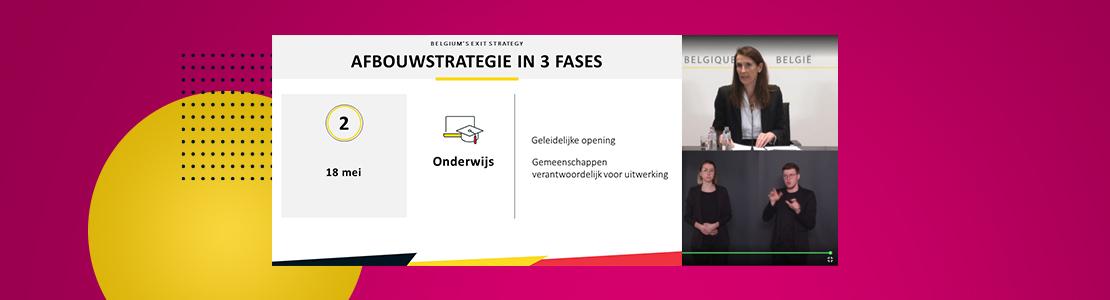
The whole of Belgium looked forward eagerly on Friday evening to the results of the Security Council. The criticism of the way the Security Council and the prime minister communicated had already grown over a few days and weeks. How would they tackle it this time?
For many, the presentation itself was an absolute anticlimax. Communication specialists denounced the way it was delivered and many messages also appeared about the presentation used. Few in a positive sense. I too gave my opinion on it in a post on LinkedIn and, to be honest, never before had I received so many reactions.
We are a few days on and I now want to approach it positively and in an advisory way for a moment. How could they have tackled this differently? How could they have used the presentation as a moment of leadership and clear communication?
Friday evening 24 April 2020 was the moment for prime minister Wilmès to act decisively as leader of our country. The whole country was waiting for the message about how we will proceed over the coming weeks and months. Instead of bringing everything in a two-hour-long, boring presentation, they had better split its content into different parts and speakers.
A) A powerful address by prime minister Sophie Wilmès. Beginning with an address as we saw from Messrs Rutten and Macron. To thank the population, to call on them and to give hope. And of course you do that best without PowerPoint…
An address in which she looks the people straight in the eye and addresses them directly and decisively.
B) Substantive explanation of the course and conditions of the exit strategy.
Detailed explanation of the various phases that the plan comprises. Clearly explained step by step what we can expect over the coming weeks and months. This part she could have left perfectly and entirely to the ministers of the federated states and/or other experts from the Security Council. In doing so, I also dare to raise the question of whether this explanation had to be given in full on Friday evening at 10 pm. Perhaps a moment the following day could have been chosen for this too. But that is another discussion.
In this phase (to use the fine word once again) it is of course necessary to reinforce the message with a strongly supportive and graphic PowerPoint. A calm build-up with graphic elements and key words. A presentation on which only the necessary information is shown and which reinforces the spoken message. We have cast the heart of the story into a new design for a moment.
We simply live in a country with three official languages and that must, at an official address, be taken into account. But letting a Dutch-speaker speak and showing French-language slides alongside really does not work. It only sows confusion. We try to listen and understand the slides in one movement and that is virtually impossible even for people who are perfectly bilingual.
Control and checking
In a presentation on which your reputation depends, control and checking are very important. You do not want to be caught out on parts of your presentation that draw attention away from the heart of the message.
These are of course only a few recommendations and take no account of protocol guidelines or political agendas. That is our advantage. But it does ensure a more professional image and above all a clear transfer of the information.
Anyone can make a PowerPoint but if your reputation depends on it then you had better leave that to an expert. We are available 24/7 to the prime minister and the Security Council.
.jpg)
.png)